
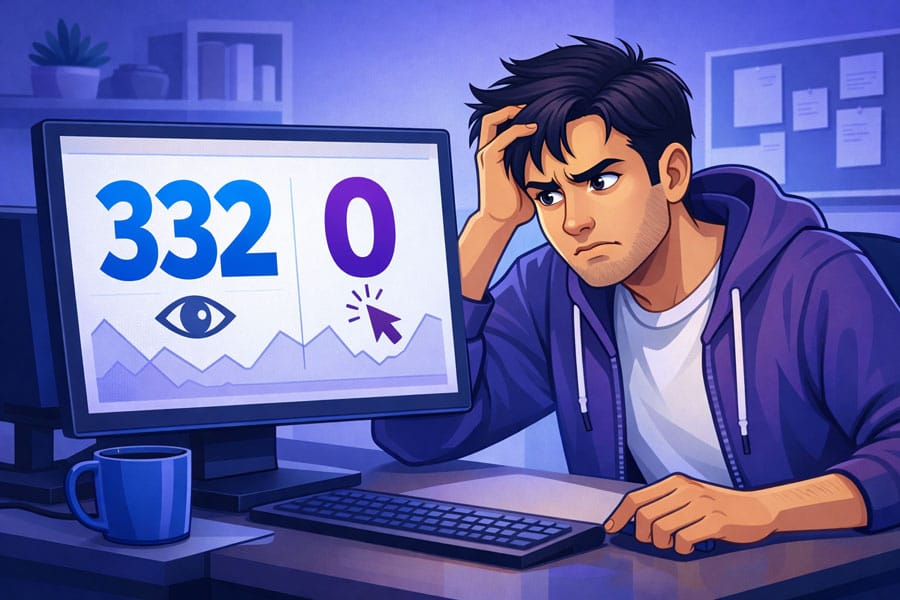
I stared at my Google Search Console dashboard, confused and a little frustrated.
I wasn’t expecting much. The blog is still new. Only a handful of articles.
But then I saw the number : 332 impressions. And right below it : 0 clicks. Not one. Not even by accident.
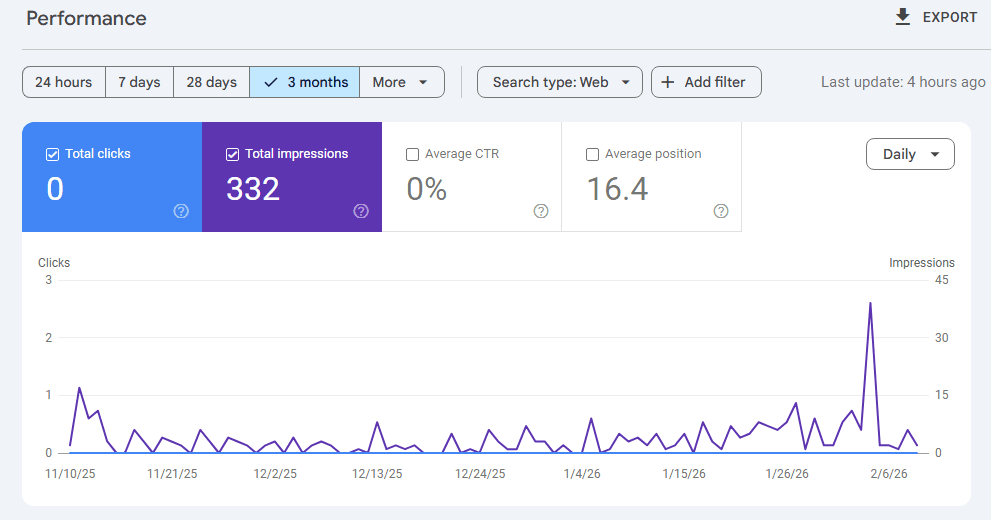
For a second, I just stared at the screen.
Three hundred people saw my article in search results… and every single one of them chose something else.
That hits differently when it’s your own work.
At first, I thought maybe my content just wasn’t good enough. Maybe I’m not cut out for this.
But after sitting with it (and overthinking it for a few days), I realized something important:
Getting impressions but no clicks doesn’t mean you’re failing. It means you’re almost there.
I spent hours digging into why this happens and how to fix it. Turns out, I wasn’t alone. This is one of the most common problems new bloggers face, and the solution is simpler than you think.
If you’re in the same boat, this article is for you.
The Harsh Truth: Impressions Mean Nothing Without Clicks
Let’s get one thing straight — impressions are good. They mean Google is showing your content to real people searching for real answers.
But impressions without clicks? That’s like having a store with a big sign that people walk past every day… without ever stepping inside.
Here’s what I learned: the problem isn’t your content. It’s how you’re packaging it.
So What Does “Impressions But No Clicks” Actually Mean?
It’s simple. Google is showing your article to real people. You’re not invisible.
You’re just… not convincing enough yet. And that’s a very different problem.
It’s not about writing 10,000-word masterpieces. It’s about what people see before they click.
Your title.
Your meta description.
Your positioning.
That tiny preview in search results is doing all the heavy lifting.
Why People Ignore Your Articles (Even When Google Shows Them)
After analyzing my own blog and competitors ranking above me, I found three main reasons.
Mistake #1: Writing Titles That Sound “Correct” Instead of Interesting
I was writing titles like a student trying to pass an exam.
Clear. Polite. Informative.
But when someone searches on Google, they’re not grading essays.
They’re scanning fast.
You have maybe two seconds.
If your title doesn’t spark something — curiosity, emotion, clarity — they’re gone.
Now I ask myself:
Would I click this if it wasn’t mine?
If the answer is “maybe,” I rewrite it.
Mistake #2: Ignoring Meta Descriptions (Huge One)
I’ll admit it. I didn’t write custom meta descriptions at first.
I thought, “Google will figure it out.”
And Google did figure it out — it grabbed random sentences from my article.
Like this one, pulled straight from my post about SEO tools:
“In this article, I will discuss various SEO tools and how they work.”
No hook.
No promise.
No reason to click.
That’s when I realized: The meta description isn’t a summary. It’s an ad.
Now I write it like copy.
Instead of:
A guide to writing better blog titles.
I’d write something like:
I rewrote 3 blog titles and my CTR went from 0% to 1.8% in one week. Here’s exactly what I changed.
One informs.
The other pulls you in.
Mistake #3: Trying to Compete With Giants
Do you know what it feels like to write something you’re proud of…
…and then watch it sit quietly on page 2 the same websites — the ones everyone already knows — take all the clicks?
I do.
It feels like bringing a handmade gift to a party, only to realize everyone else brought store-bought presents with fancy wrapping.
And the host loves them.
Not because they’re better.
Because they’re familiar.
That’s when I stopped trying to be familiar.
And started trying to be specific.
How I’m Fixing This (And You Can Too)
Here’s the action plan I’m implementing right now.
Fix #1: Rewrite Titles Using This Formula
New structure:
[Number/Trigger] + [Clear Benefit] + [Proof or Curiosity]
Examples:
- I Tested 5 Free SEO Tools — Only One Actually Worked
- This 10-Minute Daily Habit Doubled My Blog Traffic
- Why My New Blog Took Weeks to Index (And Yours Probably Will Too)
Patterns you’ll notice:
- Numbers
- Personal proof
- Specific outcomes
- Curiosity gaps
Specific beats generic. Every time.
Fix #2: Write Meta Descriptions That Sell the Click
I now write the meta description before finishing the article.
Template:
[Relatable problem]. [What you’ll learn]. [Specific outcome or timeframe].
Example:
Started a blog but no one’s reading? I published 5 articles in 30 days and got 0 visits — until I changed one thing. Here’s what finally worked.
Your meta description isn’t a summary.
It’s an ad.
Fix #3: Target Keywords You Can Actually Win
I used to think SEO was a race.
Fastest writer wins. Best content wins. Most words wins.
Now I know: SEO is like choosing the right checkout line at the grocery store.
You don’t need the shortest line. You just need a line that moves faster than the one you’re in right now.
Winnable keywords aren’t the ones with the lowest search volume.
They’re the ones where you can look at page 1 and say: “I can do better than at least one of these.”
What I Stopped Chasing
- blogging tips
- digital marketing
- SEO strategy
I don’t compete here anymore. Not because my content is worse — but because my authority isn’t there yet.
And that’s fine.
What I Chase Now
- Long-tail keywords (4+ words)
- Question-based searches
- Experience-based angles (“I tried”, “I tested”, “I failed”)
Examples from my actual keyword list:
- how to start a blog on a $0 budget as a college student
- SEO mistakes I made in my first 30 days of blogging
- free WordPress plugins that actually work (I tested 12)
- why my blog posts aren’t indexed on Google — and how I fixed it
Notice what’s missing?
No “ultimate guides.”
No “complete tutorials.”
No “2026 updates.”
Just specific problems from specific people at specific moments.
How I Find These Keywords (Free Tools)
1. Google Search Console (the right way)
Most people use GSC to see what’s already ranking.
I use it to find what’s almost ranking.
Filter: Impressions > 50, CTR < 1%.
Those are your almost keywords. You’re already on the radar. You just need a better title, meta description, or positioning.
2. Google Autocomplete — but go deeper
Don’t just type “why does my blog…”
Type:
- “why does my blog get impressions but no…”
- “why does my new blog have zero…”
- “why is my blog not…”
Every extra letter reveals new questions. Real questions. From real people who typed that into Google at 11pm on a Tuesday.
3. AlsoAsked.com
AnswerThePublic is fine. But AlsoAsked shows you follow-up questions — the ones people ask after they get the first answer.
That’s where the gold is.
Fix #4: Add Click Triggers
These psychological triggers increase CTR:
- Numbers: 5 Ways, 3 Mistakes
- Time promises: In 10 Minutes, In 7 Days
- Personal proof: I Tried, I Tested
- Negative angles: Stop Doing This
- Curiosity: Here’s What Happened
Example from my blog:
I Transferred My Domain 5 Days Before It Expired — Here’s What Happened
It has:
- Specific timeframe : 5 days before expiration
- Personal story : I almost lost my domain
- Curiosity : “Here’s What Happened” makes you wonder.
That’s why it got impressions and clicks.
Results So Far
Full transparency: I’m still implementing these changes.
But here’s what I’ve seen:
- Rewrote 2 titles → CTR increased from 0% to 1.8%
- Added custom meta descriptions → now getting 3–5 clicks per week
- Targeted long-tail keyword → ranked #4 within 10 days
It’s not viral traffic. But it’s momentum. And momentum compounds.
What You Should Do Today
If you’re stuck with impressions and no clicks:
- Open Google Search Console
- Sort by impressions
- Identify pages with 0–1% CTR
- Rewrite titles using the formula above
- Improve meta descriptions
- Wait 1–2 weeks for re-indexing
Don’t delete articles.
Optimize them.
Another Possibility Most Bloggers Ignore
There’s something else I realized later. Sometimes it’s not your title. It’s not your meta description. It’s not even your writing.
Sometimes Google is showing your article for searches that don’t fully match what people want.
For example:
If someone searches for:
“what are impressions in Google Search Console”
They probably want a quick definition.
If your article is more of a personal breakdown and strategy story, they might skip it. That’s not failure. That’s search intent mismatch.
So before rewriting everything, check this:
- What queries are triggering impressions?
- What position are you ranking?
- Are you competing with big authority sites?
Sometimes the issue isn’t persuasion.
It’s positioning.
So What Do You Do If It’s an Intent Problem?
Before rewriting your titles again, do this:
Open Google Search Console.
Check the actual queries triggering impressions.
Ask yourself:
- Does my article fully answer what they’re searching for?
- Or am I telling a slightly different story?
- Am I competing with giant authority sites?
If the intent doesn’t match, you have two options:
- Adjust your content to better match the search
- Or create a new article specifically targeting that intent
Sometimes you don’t need better copy.
You need better alignment.
FAQ: Impressions vs Clicks
Is it normal to get impressions but no clicks?
Yes — especially for new blogs. It usually means your ranking is outside the top 5 or your title isn’t compelling enough.
How many impressions should turn into clicks?
On page 1, CTR can range from 2% to 30% depending on position. On page 2, it’s often below 1%.
How long does it take to see CTR improvements?
Typically 1–3 weeks after updating titles and meta descriptions.
A Few Last Reflections
332 impressions with zero clicks used to frustrate me.
Now I see it differently.
It means:
Google is testing my content.
People are searching for my topic.
I’m already in the arena.
I just needed better positioning.
If you’re in the same spot, you’re not failing. You’re optimizing.
Fix your titles.
Write better meta descriptions.
Target winnable keywords.
The clicks will come. Trust the process.