
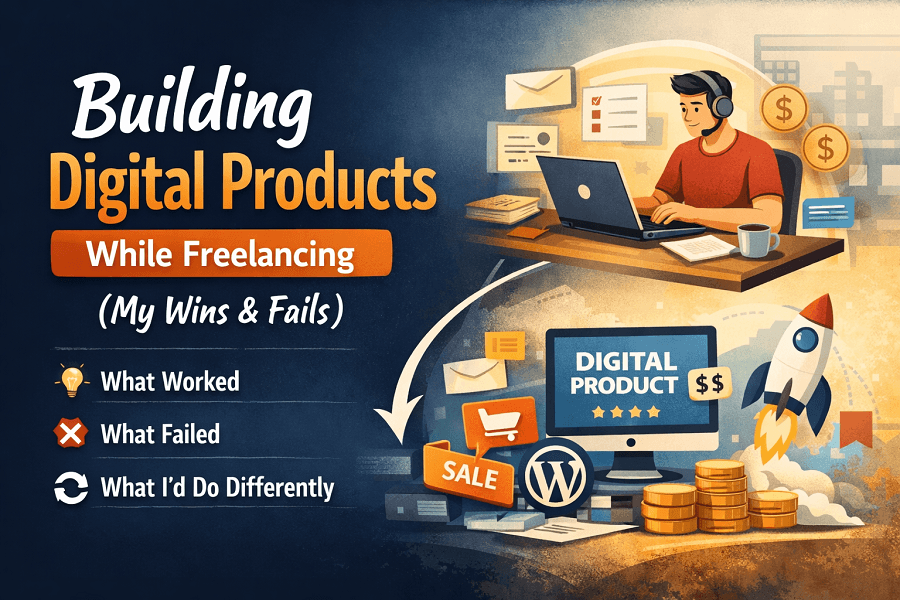
Two years into freelancing, I thought I had a solid system going.
Get a client → finish the project → get paid → repeat.
It felt stable. It felt like progress. Until one night I opened my laptop and realized something uncomfortable:
If I stopped working next week, my income would drop to zero.
Nothing was working while I slept. Nothing continued while I was sick. Everything depended entirely on my time and energy.
That’s when I got serious about building digital products.
Why Digital Products? And Why Is It So Hard for Freelancers?
The idea is simple enough: build something once, sell it multiple times. A template, a plugin, a WordPress theme, an ebook — something that generates income without you being actively present.
Sounds great in theory. In practice? It’s harder than it looks — especially when you’re still running active client projects.
The challenge isn’t skill. I already knew how to build websites, android app, write PHP, and design interfaces. The real challenge is energy and focus.
Here’s what a typical workday looked like for me:
- Morning: reply to client emails, clarify briefs
- Afternoon: handle revisions that came out of nowhere
- Evening: debug a feature that was supposed to be done yesterday
- Night: sit in front of my laptop, fully intending to work on my own product
And almost every night, I didn’t start. Not because I was lazy. But because I had nothing left to give after a full day of client work.
3 Mistakes That Slowed Me Down for Almost 8 Months
I didn’t figure this out quickly. There was a long period where I was “planning” but not producing anything. Looking back, these were the three biggest mistakes:
Mistake 1: Waiting for Free Time That Never Came
I kept telling myself: “I’ll start when things slow down.”
But freelancing doesn’t slow down. When one project ends, another one comes in. And when there’s no project, the anxiety about income takes over — which is somehow even more draining.
I finally accepted the truth: if I didn’t deliberately make time for this, that time would never appear on its own.
What I do now: block 45–60 minutes every morning, before opening any client emails. It doesn’t have to be wildly productive. It just has to be consistent.
Mistake 2: Spending Too Long in “Planning Mode”
I once spent three full weeks doing nothing but “research and planning” for a product. I wrote long documents. Built out feature outlines. Even started designing mockups.
Nothing shipped.
I was so focused on making it perfect before starting that I forgot the most basic truth: a perfectly planned product that never launches is worth exactly nothing.
Mistake 3: Building Without Validation
Once, I almost spent several weeks building a content management tool that — after talking to a few people — nobody actually needed in the format I was imagining.
Time almost completely wasted because I trusted my own assumptions too much.
The lesson I took from this: don’t build what you think is cool. Build what other people actually need. Your opinion of your own product is the least reliable data point you have. The market decides — not you.
What Finally Worked
After trial and error, I started changing my approach. And this is what made a difference.
1. Starting Small
At first, it didn’t feel like a big shift. It almost felt like I was doing less, not more.
But over time, I started to notice something changing. Things were actually getting done. Ideas that used to stay in my head were finally becoming real, even if they were simple.
And that changed the way I see progress.
It’s not always about building something big or impressive from the start. Sometimes, it’s just about getting something out there — something real, something useful — and letting that be enough for now.
2. Turning Client Work Into Product Ideas
This is what genuinely changed my approach.
I was working on a website project for a client in the hospitality industry. On the surface, it felt like just another job. But as I worked through it, I started noticing things that kept coming up:
- They needed a simple booking system
- Room listing pages followed almost the same structure across every hotel
- The layout had to be conversion-focused, not just visually impressive
- The gallery needed to be easy to update without technical help
And then it hit me: this isn’t one client’s problem. This is a recurring need across hundreds of small hotels.
That’s where the idea for a WordPress theme built specifically for hotels came from. Not from a brainstorming session. Not from keyword research. From a client project that was already in progress.
This is the pattern I now look for: Every client project contains repeating problems. The question isn’t “what product would be cool to build?” It’s “what problem do I keep solving for different clients?”
The same thing happened with property sites: I kept solving the same listing, filter, and location problems, which eventually became a lightweight real estate WordPress theme.
3. Done Is Better Than Perfect
At some point, I realized something…
I was stuck not because I didn’t know what to build. But because I kept trying to make everything perfect.
I would spend too much time on small things. Fixing details that probably didn’t matter. Changing things that were already “good enough.”
And somehow… I felt like I was being productive. But nothing was actually finished.
That’s when it hit me: “Done is better than perfect.”
Not because perfect is bad. But because chasing it too early just slows everything down.
The few things I actually finished — even if they were far from perfect — were the only ones that gave me something real. Feedback. Experience. Even a few sales.
And that made me realize something simple: People don’t care if your product is perfect. They care if it solves their problem.
That’s it. I’m still learning this, by the way. Sometimes I still catch myself overthinking things again. But now at least I know that shipping something imperfect is still better than not shipping at all.
Real Results So Far (Honest, Not Hyped)
The WordPress theme I built from that observation has sold a few times. It’s not a big number. It’s not going viral — mainly because I haven’t promoted it aggressively yet.
But it proved something important to me:
Other people have the same problem, and they’re willing to pay for a solution.
The first time I got a sale notification while I was relaxing — that moment changed how I see everything.
I wasn’t doing anything. But the product was working for me.
Right now I’m working on a few other products, all developed from the same pattern-spotting approach. The process is slow, but it gets more systematic over time.
The Part No One Likes
Even with progress, it’s still not easy.
There were times where things just felt painfully slow. Days went by and it seemed like nothing was really happening. I’d put in the effort, publish something, tweak things here and there — only to see little to no results.
Sometimes the results just didn’t show up at all. Or worse, they showed up in a way that didn’t feel rewarding. Like when I saw impressions coming in, but zero clicks — something I explained in my post about getting impressions but no clicks and how I fixed it.
And honestly, that’s the part no one really talks about.
The gap between effort and outcome can feel huge. You keep showing up, keep building, but there’s no clear signal telling you you’re on the right track. It makes you question everything—your strategy, your skills, even whether this is worth continuing.
But going through that made me realize something important:
Progress doesn’t always look obvious at the beginning.
Sometimes it’s hidden in small signals. Sometimes it shows up later than you expect. And sometimes, it only makes sense when you look back.
Questions I Wish Someone Had Answered for Me
Do I need to stop freelancing first to focus on building products?
No — and I’d actually argue against it. Client projects are your best source of product ideas. What needs to change isn’t the activity. It’s how you look at it.
How long until the first sale?
For me, about 6 weeks after the first product went live. Important caveat: that product wasn’t built from scratch. It was developed from a client project base that already existed.
What kind of product makes the most sense for a freelancer just starting out?
Start closest to what you already do. If you frequently build proposal templates for clients — that’s already a product. If you always set up the same things at the start of every WordPress project — that could be a starter kit or a small plugin.
Do I need an audience first?
Not necessarily. I didn’t have a large audience when my first product sold. I listed it on a marketplace, not through my own following.
What I’d Do Differently From Day One
If I could go back and restart, here’s what I’d do from the beginning:
- Write down every recurring problem from client work — not to complain about it, but to turn it into a product idea
- Set an extremely small first target — not a platform, not a suite of tools. One template. One small function.
- Ship something imperfect — real feedback from real users is worth more than a perfect plan inside your head
- Protect time for your own work — even 45 minutes a day adds up to over 270 hours a year
Freelancing vs Digital Products: Not a Choice, a Combination
The most important thing I’ve learned: these two don’t have to be in conflict.
Freelancing gives you consistent, immediate income. Digital products build assets that generate income even when you’re not working. They complement each other — especially early on, when your products aren’t making much yet.
You don’t have to choose one. You just have to start building the second one while keeping the first one running.
The gap between “thinking about it” and actually shipping something is smaller than it feels.
If you’re in the same boat, I hope this saves you some of the time I wasted figuring it out the hard way.